Richard Gerver

“So how did you spend your weekend? Anything interesting?”

This is the stuff of Monday morning conversations in many walks of life – and so it is in our staffroom.

“I went to this amazing education conference,” I reply enthusiastically. I can feel the spirit drain from the room. The words “busman” and “holiday” come to mind.

Well I don’t care, because at this particular conference I got to hear – for free – Richard Gerver talking about the change our schools need in order to engage children. I will quote shamelessly from his website:

Gerver began his working life as an actor who worked as an advertising copywriter to make ends meet. He began a teaching career in 1992 and rose through the ranks fast being identified by the school’s inspectorate in 1997 as one of the most outstanding teachers in the country. By 2005, he had won the prestigious School Head Teacher of the Year Award at the British National Teaching Awards for his work in leading a school on the brink of closure to becoming one of the most innovative in the world. Gerver developed his organisational philosophy of living, learning and laughing which reached his full development during his time as Head Teacher.

By 2003, Gerver was working with Tony Blair’s Government as an advisor on education policy. In 2006, his work was celebrated at The UNESCO World Arts Education Conference in Lisbon, Portugal and in the same year he was invited to Shanghai to speak about education transformation to members of the Chinese Government.

You can watch him here and in a few other clips in YouTubeLand. He is interesting, inspirational and makes it feel like an exciting time to be involved with education.

Ken Robinson’s 2006 TED talk – a full transcript

Here, for the benefit of those who don’t YouTube, is some Christmas food for thought.  But beware the bogus ‘brain sex’ paragraph: the most extensive research shows that while our brains are physically different, our minds are not ‘hard wired’.  See Tanya Byron’s work, for example, on brain plasticity and social construction.

Good morning. How are you? It’s been great, hasn’t it? I’ve been blown away by the whole thing. In fact, I’m leaving. (Laughter) There have been three themes, haven’t there, running through the conference, which are relevant to what I want to talk about. One is the extraordinary evidence of human creativity in all of the presentations that we’ve had and in all of the people here. Just the variety of it and the range of it. The second is that it’s put us in a place where we have no idea what’s going to happen, in terms of the future. No idea how this may play out.

I have an interest in education — actually, what I find is everybody has an interest in education. Don’t you? I find this very interesting. If you’re at a dinner party, and you say you work in education — actually, you’re not often at dinner parties, frankly, if you work in education. (Laughter) You’re not asked. And you’re never asked back, curiously. That’s strange to me. But if you are, and you say to somebody, you know, they say, “What do you do?” and you say you work in education, you can see the blood run from their face. They’re like, “Oh my God,” you know, “Why me? My one night out all week.” (Laughter) But if you ask about their education, they pin you to the wall. Because it’s one of those things that goes deep with people, am I right? Like religion, and money and other things. I have a big interest in education, and I think we all do. We have a huge vested interest in it, partly because it’s education that’s meant to take us into this future that we can’t grasp. If you think of it, children starting school this year will be retiring in 2065. Nobody has a clue — despite all the expertise that’s been on parade for the past four days — what the world will look like in five years’ time. And yet we’re meant to be educating them for it. So the unpredictability, I think, is extraordinary.

And the third part of this is that we’ve all agreed, nonetheless, on the really extraordinary capacities that children have — their capacities for innovation. I mean, Sirena last night was a marvel, wasn’t she? Just seeing what she could do. And she’s exceptional, but I think she’s not, so to speak, exceptional in the whole of childhood. What you have there is a person of extraordinary dedication who found a talent. And my contention is, all kids have tremendous talents. And we squander them, pretty ruthlessly. So I want to talk about education and I want to talk about creativity. My contention is that creativity now is as important in education as literacy, and we should treat it with the same status. (Applause) Thank you. That was it, by the way. Thank you very much. (Laughter) So, 15 minutes left. Well, I was born … no. (Laughter)

I heard a great story recently — I love telling it — of a little girl who was in a drawing lesson. She was six and she was at the back, drawing, and the teacher said this little girl hardly ever paid attention, and in this drawing lesson she did. The teacher was fascinated and she went over to her and she said, “What are you drawing?” And the girl said, “I’m drawing a picture of God.” And the teacher said, “But nobody knows what God looks like.” And the girl said, “They will in a minute.” (Laughter)

When my son was four in England — actually he was four everywhere, to be honest. (Laughter) If we’re being strict about it, wherever he went, he was four that year. He was in the Nativity play. Do you remember the story? No, it was big. It was a big story. Mel Gibson did the sequel. You may have seen it: “Nativity II.” But James got the part of Joseph, which we were thrilled about. We considered this to be one of the lead parts. We had the place crammed full of agents in T-shirts: “James Robinson IS Joseph!” (Laughter) He didn’t have to speak, but you know the bit where the three kings come in. They come in bearing gifts, and they bring gold, frankincense and myrhh. This really happened. We were sitting there and I think they just went out of sequence, because we talked to the little boy afterward and we said, “You OK with that?” And he said, “Yeah, why? Was that wrong?” They just switched, that was it. Anyway, the three boys came in — four-year-olds with tea towels on their heads — and they put these boxes down, and the first boy said, “I bring you gold.” And the second boy said, “I bring you myrhh.” And the third boy said, “Frank sent this.” (Laughter)

What these things have in common is that kids will take a chance. If they don’t know, they’ll have a go. Am I right? They’re not frightened of being wrong. Now, I don’t mean to say that being wrong is the same thing as being creative. What we do know is, if you’re not prepared to be wrong, you’ll never come up with anything original — if you’re not prepared to be wrong. And by the time they get to be adults, most kids have lost that capacity. They have become frightened of being wrong. And we run our companies like this, by the way. We stigmatize mistakes. And we’re now running national education systems where mistakes are the worst thing you can make. And the result is that we are educating people out of their creative capacities. Picasso once said this — he said that all children are born artists. The problem is to remain an artist as we grow up. I believe this passionately, that we don’t grow into creativity, we grow out of it. Or rather, we get educated out if it. So why is this?

I lived in Stratford-on-Avon until about five years ago. In fact, we moved from Stratford to Los Angeles. So you can imagine what a seamless transition that was. (Laughter) Actually, we lived in a place called Snitterfield, just outside Stratford, which is where Shakespeare’s father was born. Are you struck by a new thought? I was. You don’t think of Shakespeare having a father, do you? Do you? Because you don’t think of Shakespeare being a child, do you? Shakespeare being seven? I never thought of it. I mean, he was seven at some point. He was in somebody’s English class, wasn’t he? How annoying would that be? (Laughter) “Must try harder.” Being sent to bed by his dad, you know, to Shakespeare, “Go to bed, now,” to William Shakespeare, “and put the pencil down. And stop speaking like that. It’s confusing everybody.” (Laughter)

Anyway, we moved from Stratford to Los Angeles, and I just want to say a word about the transition, actually. My son didn’t want to come. I’ve got two kids. He’s 21 now; my daughter’s 16. He didn’t want to come to Los Angeles. He loved it, but he had a girlfriend in England. This was the love of his life, Sarah. He’d known her for a month. Mind you, they’d had their fourth anniversary, because it’s a long time when you’re 16. Anyway, he was really upset on the plane, and he said, “I’ll never find another girl like Sarah.” And we were rather pleased about that, frankly, because she was the main reason we were leaving the country. (Laughter)

But something strikes you when you move to America and when you travel around the world: Every education system on earth has the same hierarchy of subjects. Every one. Doesn’t matter where you go. You’d think it would be otherwise, but it isn’t. At the top are mathematics and languages, then the humanities, and the bottom are the arts. Everywhere on Earth. And in pretty much every system too, there’s a hierarchy within the arts. Art and music are normally given a higher status in schools than drama and dance. There isn’t an education system on the planet that teaches dance everyday to children the way we teach them mathematics. Why? Why not? I think this is rather important. I think math is very important, but so is dance. Children dance all the time if they’re allowed to, we all do. We all have bodies, don’t we? Did I miss a meeting? (Laughter) Truthfully, what happens is, as children grow up, we start to educate them progressively from the waist up. And then we focus on their heads. And slightly to one side.

If you were to visit education, as an alien, and say “What’s it for, public education?” I think you’d have to conclude — if you look at the output, who really succeeds by this, who does everything that they should, who gets all the brownie points, who are the winners — I think you’d have to conclude the whole purpose of public education throughout the world is to produce university professors. Isn’t it? They’re the people who come out the top. And I used to be one, so there. (Laughter) And I like university professors, but you know, we shouldn’t hold them up as the high-water mark of all human achievement. They’re just a form of life, another form of life. But they’re rather curious, and I say this out of affection for them. There’s something curious about professors in my experience — not all of them, but typically — they live in their heads. They live up there, and slightly to one side. They’re disembodied, you know, in a kind of literal way. They look upon their body as a form of transport for their heads, don’t they? (Laughter) It’s a way of getting their head to meetings. If you want real evidence of out-of-body experiences, by the way, get yourself along to a residential conference of senior academics, and pop into the discotheque on the final night. (Laughter) And there you will see it — grown men and women writhing uncontrollably, off the beat, waiting until it ends so they can go home and write a paper about it.

Now our education system is predicated on the idea of academic ability. And there’s a reason. The whole system was invented — around the world, there were no public systems of education, really, before the 19th century. They all came into being to meet the needs of industrialism. So the hierarchy is rooted on two ideas. Number one, that the most useful subjects for work are at the top. So you were probably steered benignly away from things at school when you were a kid, things you liked, on the grounds that you would never get a job doing that. Is that right? Don’t do music, you’re not going to be a musician; don’t do art, you won’t be an artist. Benign advice — now, profoundly mistaken. The whole world is engulfed in a revolution. And the second is academic ability, which has really come to dominate our view of intelligence, because the universities designed the system in their image. If you think of it, the whole system of public education around the world is a protracted process of university entrance. And the consequence is that many highly talented, brilliant, creative people think they’re not, because the thing they were good at at school wasn’t valued, or was actually stigmatized. And I think we can’t afford to go on that way.

In the next 30 years, according to UNESCO, more people worldwide will be graduating through education than since the beginning of history. More people, and it’s the combination of all the things we’ve talked about — technology and its transformation effect on work, and demography and the huge explosion in population. Suddenly, degrees aren’t worth anything. Isn’t that true? When I was a student, if you had a degree, you had a job. If you didn’t have a job it’s because you didn’t want one. And I didn’t want one, frankly. (Laughter) But now kids with degrees are often heading home to carry on playing video games, because you need an MA where the previous job required a BA, and now you need a PhD for the other. It’s a process of academic inflation. And it indicates the whole structure of education is shifting beneath our feet. We need to radically rethink our view of intelligence.

We know three things about intelligence. One, it’s diverse. We think about the world in all the ways that we experience it. We think visually, we think in sound, we think kinesthetically. We think in abstract terms, we think in movement. Secondly, intelligence is dynamic. If you look at the interactions of a human brain, as we heard yesterday from a number of presentations, intelligence is wonderfully interactive. The brain isn’t divided into compartments. In fact, creativity — which I define as the process of having original ideas that have value — more often than not comes about through the interaction of different disciplinary ways of seeing things.

The brain is intentionally — by the way, there’s a shaft of nerves that joins the two halves of the brain called the corpus callosum. It’s thicker in women. Following off from Helen yesterday, I think this is probably why women are better at multi-tasking. Because you are, aren’t you? There’s a raft of research, but I know it from my personal life. If my wife is cooking a meal at home — which is not often, thankfully. (Laughter) But you know, she’s doing — no, she’s good at some things — but if she’s cooking, you know, she’s dealing with people on the phone, she’s talking to the kids, she’s painting the ceiling, she’s doing open-heart surgery over here. If I’m cooking, the door is shut, the kids are out, the phone’s on the hook, if she comes in I get annoyed. I say, “Terry, please, I’m trying to fry an egg in here. Give me a break.” (Laughter) Actually, you know that old philosophical thing, if a tree falls in a forest and nobody hears it, did it happen? Remember that old chestnut? I saw a great t-shirt really recently which said, “If a man speaks his mind in a forest, and no woman hears him, is he still wrong?” (Laughter)

And the third thing about intelligence is, it’s distinct. I’m doing a new book at the moment called “Epiphany,” which is based on a series of interviews with people about how they discovered their talent. I’m fascinated by how people got to be there. It’s really prompted by a conversation I had with a wonderful woman who maybe most people have never heard of; she’s called Gillian Lynne — have you heard of her? Some have. She’s a choreographer and everybody knows her work. She did “Cats” and “Phantom of the Opera.” She’s wonderful. I used to be on the board of the Royal Ballet in England, as you can see. Anyway, Gillian and I had lunch one day and I said, “Gillian, how’d you get to be a dancer?” And she said it was interesting; when she was at school, she was really hopeless. And the school, in the ’30s, wrote to her parents and said, “We think Gillian has a learning disorder.” She couldn’t concentrate; she was fidgeting. I think now they’d say she had ADHD. Wouldn’t you? But this was the 1930s, and ADHD hadn’t been invented at this point. It wasn’t an available condition. (Laughter) People weren’t aware they could have that.

Anyway, she went to see this specialist. So, this oak-paneled room, and she was there with her mother, and she was led and sat on this chair at the end, and she sat on her hands for 20 minutes while this man talked to her mother about all the problems Gillian was having at school. And at the end of it — because she was disturbing people; her homework was always late; and so on, little kid of eight — in the end, the doctor went and sat next to Gillian and said, “Gillian, I’ve listened to all these things that your mother’s told me, and I need to speak to her privately.” He said, “Wait here. We’ll be back; we won’t be very long,” and they went and left her. But as they went out the room, he turned on the radio that was sitting on his desk. And when they got out the room, he said to her mother, “Just stand and watch her.” And the minute they left the room, she said, she was on her feet, moving to the music. And they watched for a few minutes and he turned to her mother and said, “Mrs. Lynne, Gillian isn’t sick; she’s a dancer. Take her to a dance school.”

I said, “What happened?” She said, “She did. I can’t tell you how wonderful it was. We walked in this room and it was full of people like me. People who couldn’t sit still. People who had to move to think.” Who had to move to think. They did ballet; they did tap; they did jazz; they did modern; they did contemporary. She was eventually auditioned for the Royal Ballet School; she became a soloist; she had a wonderful career at the Royal Ballet. She eventually graduated from the Royal Ballet School and founded her own company — the Gillian Lynne Dance Company — met Andrew Lloyd Weber. She’s been responsible for some of the most successful musical theater productions in history; she’s given pleasure to millions; and she’s a multi-millionaire. Somebody else might have put her on medication and told her to calm down.

Now, I think … (Applause) What I think it comes to is this: Al Gore spoke the other night about ecology and the revolution that was triggered by Rachel Carson. I believe our only hope for the future is to adopt a new conception of human ecology, one in which we start to reconstitute our conception of the richness of human capacity. Our education system has mined our minds in the way that we strip-mine the earth: for a particular commodity. And for the future, it won’t serve us. We have to rethink the fundamental principles on which we’re educating our children. There was a wonderful quote by Jonas Salk, who said, “If all the insects were to disappear from the earth, within 50 years all life on Earth would end. If all human beings disappeared from the earth, within 50 years all forms of life would flourish.” And he’s right.

What TED celebrates is the gift of the human imagination. We have to be careful now that we use this gift wisely and that we avert some of the scenarios that we’ve talked about. And the only way we’ll do it is by seeing our creative capacities for the richness they are and seeing our children for the hope that they are. And our task is to educate their whole being, so they can face this future. By the way — we may not see this future, but they will. And our job is to help them make something of it. Thank you very much.

A sneaky way of improving literacy

Now I’m unusual.  I was reading the Telegraph at the age of six and had the reading age of an eighteen year-old when I was eight.  But that’s down to flashcards and a mother who thought that all two year-olds should read.

For a gentler way to inculcate literariness (try saying that after some festive spirit) you can’t go wrong with having Radio 4 (or Radio 4 Extra, for the digitally inclined) playing in the background.  All the time.  Even when those irritating Ambridge folk start whining about, well, everything.

Because, while I was able to decode from an early age, context and meaning matter a lot.  I was brought up in a different age and, for some of my childhood, in a different country.

There wasn’t too much telly in the sixties, and certainly very little British content in Dusseldorf, Kuala Lumpur or Lahore, so we read a lot.  Or swam, or ate too much playdough and were sick, or played in the piles of cement around the blocks of flats and got it everywhere…

And then there was Swaziland, happy mountain kingdom nestling between mighty South Africa and Marxist Mozambique.  I lived here from the age of 11 until I was 13 – for my holidays from boarding school, at least.  In the mid-seventies, we didn’t have TV at all.  It was SABC or Springbok Radio, or a trip to the cinema.  And radio was very, very old-fashioned, like Britain or America in the fifties.  SABC was the public provider: programmes were modelled on (and sometimes taken from) the BBC Home Service.  Springbok was the commercial provider: programmes mostly imitated their American equivalents.  “Jet Jungle is brought to you by the makers of Jungle Oats and Black Cat peanut butter… and now for Squad Cars, sponsored by Chevrolet, the nation’s favourite car…”  There were children’s programmes, game shows, adventure series, comedy programmes, soaps, plays, serialised books and a great deal more.  There is a difference between being glued to a telly and having meaning spelt out for you, and radio programmes that allow you to play – or even read – and leave your imagination to add colour and detail.

Finally, there was Paris.  I learnt my reasonable French, in part, from gawping at local TV: they were running ‘Countdown’ (aka Chiffres et Lettres) years before us.  And Valerie Giscard d’Estang was a gift for a would-be French speaker, because he spoke so slowly and patronisingly to his plebeian people.  Hearing John Wayne drawl movingly from the foot of the cross in The Greatest Story Ever Told, “Vraiment, il était le fils de Dieu,” both informed and hugely amused me.

But Paris, most importantly, introduced me to Long Wave.  Those radio signals loped easily across the flat northern French landscape to our house in Feucherolles with a daily delivery of Radio 4.  From the age of fourteen, I learnt to cook at the feet of Sue McGregor, about gardening with Bill Sowerbutts and Professor Alan Gemmell, about the world with From our own correspondent, and about countless books and plays with the prodigious programming of this brilliant public service.

It is no accident that I was the highest scorer in a UK children’s general knowledge competition at the age of 15.  Nor that my daughter, in turn, is a ferociously articulate and generally knowledgeable young woman.  This morning, as I began to type this, she was in the bath with Saturday Live playing.  On Radio 4.

A caveat.  The clever people at Radio 4, progressive and permissive to a woman and/or man, believe that it is alright to broadcast age-inappropriate content at a time when children might want to listen.  I remember listening to an afternoon play with my daughter when she was six (we were painting fence posts together) and having to run for the off switch as the invective poured out.  It’s NOT OK to broadcast content like this as it excludes the next generation of listeners, whose education actually matters more than ours (given that the BBC’s mission includes education).  And it took a child in my class last year, talking to a parent who produces television programmes, to point that out.  “Please don’t include swearing in your programmes because we want to watch them.”

ps anyone unfortunate enough to catch Simon Gray’s play, Otherwise Engaged, will have been treated to various examples of age-inappropriate language. I’ve complained and look forward to hearing the response.

Ice and Snow

A seasonal post: a poem I wrote three years ago.

I’m more at home when out
on icy city streets,
for all their seeming cruelty,
on salty pavements,
cold-surfaced, tramped bare,
endlessly worn, glassily patched
and – for all their occasional danger
– somehow warmer;

less at home when in
these snowy outskirts,
thick-blanketed, seemingly safe
but seething under silent cover,
smothered by the oneness,
the over-wintering whiteness
which – for all its softness – hides
a hard and unforgiving earth.

Alison Peacock – an inspiration to me

I first encountered Alison Peacock when I was training at the Institute of Education.

She spoke simply and powerfully about her school and her approach to learning.  Quite simply, Alison advocates democratic schooling.  In practice, this means encouraging – and teaching – children to take responsibility for their own learning.  It requires ambition, trust in her teachers and a whole school approach.  For example, mixed ability teaching in which children choose the level of challenge they want to take on.  To begin with, they may aim too high or too low.  But eventually, they push themselves: children who are motivated by their own learning don’t want to tread water.  As Tanya Byron, author of the government review on children’s safety in a digital world, pointed out, no child playing video games wants to stay at Level One.

Her school, the Wroxham School, seems a happy, slightly mad and unorthodox place, with a stationary motorbike on which children read, a double decker bus that serves as a library (she bought it on ebay). But it is also a national teaching school and Alison spoke at the CBI conference and is listened to by the high and mighty.

As I can’t help myself, I asked her two questions. Firstly, how can I get to work for her? And secondly, what happens when the children get to secondary schools, where democracy doesn’t go down well with teachers? She thought for a moment, then said, “We just have to prepare them in the best way we can.”

I met a few of her colleagues at a course last year. The man who was running the course began by quite modestly pointing out that with six Level 6 pupils in his class, he must be doing something right. I’m not a huge fan of Level 6, but liked what he had to say about his language-rich classroom and his uncompromising ambition for his children. I won’t dwell on tne details (many of which escaped my tired attention) but it felt such a good, optimistic and humane approach.

The men on the course were young, articulate and passionate teachers, excited about their literacy. What made them stand out was the depth of intellectual discussion: this felt more like a postgraduate seminar than staffroom chatter.

They blog, they use videos, they lob gothic fiction, Pope and Shelley at their children. They encourage their children to indulge in a literary form of ‘planking’ – “Caught you reading” – in which children have themselves photographed reading in unusual but (depending on the title of their books) appropriate locations. A bed in a furniture showroom, for example. It just sounds like such fun in their world of teaching (I shamelessly used this last year).

It shouldn’t have been a surprise that they teach at The Wroxham School. They invited me to observe their lessons: I was delighted but have, as yet, been too tired and busy to go.  Here’s a taste of their curriculum.

One man (Steve Davy, Year Four Teacher) offered me a parting shot. “Keep the faith, brother,” he called out to me, with a smile and wave to send me out into the world of teaching. I am trying to, brother, I am trying to.

His Dark Materials

I  am giving my children an unexpected Christmas present: a story I listened to ten Christmases ago.  Philip Pullman‘s trilogy, His Dark MaterialsWhy?  Because it:

  1. invites the children to question the meaning of almost everything (and therefore invokes higher-order thinking)
  2. offers a way in to literature that will enhance their own writing, should they choose to steal or learn from it
  3. presents a strong, far from perfect, female hero (Lyra) and a strong, far from perfect male hero (Will).  And an armoured polar bear (go figure).
  4. mixes some very challenging ideas about life, innocence, self-consciousness and ethics with a cracking story
  5. introduces children to a mighty work of literature, Milton’s Paradise Lost, without them knowing it.

I hope that they take advantage of my gift.

hdm215

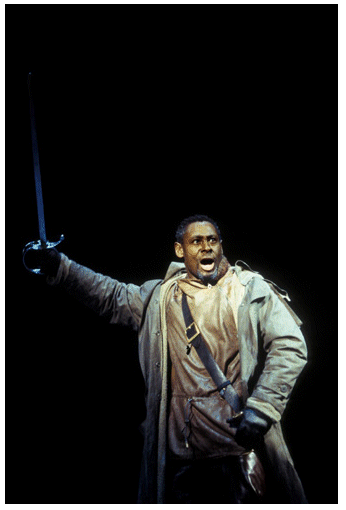
[David Harewood in the National Theatre’s production of His Dark Materials.]

A few years ago (2005 to be precise) I sat, with my wife and daughter, through six bottom-numbing hours of Nick Hytner’s production of Philip Pullman’s trilogy, His Dark Materials.  I’d been along to hear the pair of them talking about the books and the play a few days beforehand, and had the pleasure of listening to David Harewood (pictured above), who’d been sitting with fellow cast members in the audience, ask his author and director questions.  David, a majestic and powerful Lord Asriel, autographed my tatty copy of Northern Lights.

Two years earlier, over a Christmas holiday, I had listened to BBC Radio 4’s adaptation of the stories: I was transfixed.  Magical stories of childhood, danger, armoured bears, Heaven and Hell, animals, hot air balloons, gypsies and so much more.

Somewhere in between, I read the trilogy – to myself and then to my nine year-old daughter (on occasions over a speakerphone in a conference room at Norwich Union Life’s York offices).  They were our books; it was our world.

And a little later, while studying my specialist subject of children’s literature as part of my BA in English, I wrote about the book.  Here is a copy of my Pullman Essay if you’re really finding it hard to sleep.  No, really.  Interestingly, the final lines of the essay bring me back to my favourite subject: my daughter.

As an adult, I can distinguish the revolutionary from
the traditional.  For a nine year-old child, it is not so easy.  My daughter loves Lyra and her world and through its myths she has learnt more of our own world.  But when it comes to living like Lyra, she may well say, “That’s alright for her, but it’s not my place.  It’s not my destiny.”

This led me into a considerable amount of research – into Philip Pullman himself, his reasons for writing the books, the ideas that run through the stories and his continuing debate with, well, anyone who’ll listen.  One of his sparring partners was the then Archbishop of Canterbury, Rowan Williams. Here is a transcript of their discussion. Apparently they agreed on about 80% of their issues they debated.  Goodness me: you can even listen to it!

I want to draw your attention to one aspect: the loss of innocence that our children must experience if they are to become adults.  I look on my own daughter’s growing-up with a sense of bereavement – especially at this time of year, when I remember the little girl who waited breathlessly for Father Christmas but never managed to stay up to see him.

Pullman, drawing on an essay by Heinrich Kleist, argues that we cannot return to this mental Garden of Eden through the front gate: we move from a state of unconsciousness to a state of what I might call mindfulness.  We learn to live with a greater knowledge of ourselves – however unattractive that may be – and become comfortable with that knowledge.  It can take a lifetime, if we achieve it at all.

I am beginning to introduce my class to the concept of mindfulness.  Until I’d read the wiki page on it, I hadn’t realised that it drew on Buddhist thinking (handy, when our RE topic for this term is the aforesaid religion).

I came across it explicitly (it is a name for something towards which I’ve been striving for four decades) when I was talking to the seventeen year-old daughter of a friend of mine.  She is anorexic.  She looks good on it, having reached rock bottom and decided that she’d rather like to live.  But she lives with the knowledge that she may never be entirely well again.  She said she’s glad she’s had mindfulness-based psychotherapy because it has helped her deal not only with her anorexia but with growing up.  She thinks that many other teenagers face mental growing pains without that help.

So whether it’s something as serious as she’s experienced, or simply the occasional pain of growing up, a little mindfulness may help any Year 6 child.

On The Marionette Theatre

I am reproducing this in its entirety because I think that it is important and I don’t want to rely on a potentially breakable link to another website.  It is an essay by Heinrich Kleist (1777 – 1811) that, for me, is extremely pertinent to children who are leaving Primary School and beginning their education at Secondary School.

As children move from the relative safety of their one or two form primary school into the large, and for some, scary new world of ‘big school’, they may experience a painful self-consciousness.  And they may also become increasingly exposed to more ‘adult’ issues.  You can’t undo it: there’s no turning back.  If you are interested, read this article with that thought in mind.  And if you’re more interested, read what I have to say about Philip Pullman’s seminal trilogy, His Dark Materials.

Once again, as a former child, a parent and a teacher, this speaks a lot of truth to me.

One evening in the winter of 1801 I met an old friend in a public park. He had recently been appointed principal dancer at the local theatre and was enjoying immense popularity with the audiences. I told him I had been surprised to see him more than once at the marionette theatre which had been put up in the market-place to entertain the public with dramatic burlesques interspersed with song and dance. He assured me that the mute gestures of these puppets gave him much satisfaction and told me bluntly that any dancer who wished to perfect his art could learn a lot from them.

From the way he said this I could see it wasn’t something which had just come into his mind, so I sat down to question him more closely about his reasons for this remarkable assertion.

He asked me if I hadn’t in fact found some of the dance movements of the puppets (and particularly of the smaller ones) very graceful. This I couldn’t deny. A group of four peasants dancing the rondo in quick time couldn’t have been painted more delicately by Teniers.

I inquired about the mechanism of these figures. I wanted to know how it is possible, without having a maze of strings attached to one’s fingers, to move the separate limbs and extremities in the rhythm of the dance. His answer was that I must not imagine each limb as being individually positioned and moved by the operator in the various phases of the dance. Each movement, he told me, has its centre of gravity; it is enough to control this within the puppet. The limbs, which are only pendulums, then follow mechanically of their own accord, without further help. He added that this movement is very simple. When the centre of gravity is moved in a straight line, the limbs describe curves. Often shaken in a purely haphazard way, the puppet falls into a kind of rhythmic movement which resembles dance.

This observation seemed to me to throw some light at last on the enjoyment he said he got from the marionette theatre, but I was far from guessing the inferences he would draw from it later.

I asked him if he thought the operator who controls these puppets should himself be a dancer or at least have some idea of beauty in the dance. He replied that if a job is technically easy it doesn’t follow that it can be done entirely without sensitivity. The line the centre of gravity has to follow is indeed very simple, and in most cases, he believed, straight. When it is curved, the law of its curvature seems to be at the least of the first and at the most of the second order. Even in the latter case the line is only elliptical, a form of movement natural to the human body because of the joints, so this hardly demands any great skill from the operator. But, seen from another point of view, this line could be something very mysterious. It is nothing other than the path taken by the soul of the dancer. He doubted if this could be found unless the operator can transpose himself into the centre of gravity of the marionette. In other words, the operator dances.

I said the operator’s part in the business had been represented to me as something which can be done entirely without feeling – rather like turning the handle of a barrel-organ.

“Not at all”, he said. “In fact, there’s a subtle relationship between the movements of his fingers and the movements of the puppets attached to them, something like the relationship between numbers and their logarithms or between asymptote and hyperbola.” Yet he did believe this last trace of human volition could be removed from the marionettes and their dance transferred entirely to the realm of mechanical forces, even produced, as I had suggested, by turning a handle.

I told him I was astonished at the attention he was paying to this vulgar species of an art form. It wasn’t just that he thought it capable of loftier development; he seemed to be working to this end himself.

He smiled. He said he was confident that, if he could get a craftsman to construct a marionette to the specifications he had in mind, he could perform a dance with it which neither he nor any other skilled dancer of his time, not even Madame Vestris herself, could equal.

“Have you heard”, he asked, as I looked down in silence, “of those artificial legs made by English craftsmen for people who have been unfortunate enough to lose their own limbs?”

I said I hadn’t. I had never seen anything of this kind.

“I’m sorry to hear that”, he said, “because when I tell you these people dance with them, I’m almost afraid you won’t believe me. What am I saying… dance? The range of their movements is in fact limited, but those they can perform they execute with a certainty and ease and grace which must astound the thoughtful observer.”

I said with a laugh that of course he had now found his man. The craftsman who could make such remarkable limbs could surely build a complete marionette for him, to his specifications.

“And what”, I asked, as he was looking down in some perplexity, “are the requirements you think of presenting to the ingenuity of this man?”

“Nothing that isn’t to be found in these puppets we see here,” he replied: “proportion, flexibility, lightness …. but all to a higher degree. And especially a more natural arrangement of the centres of gravity.”

“And what is the advantage your puppets would have over living dancers?”

“The advantage? First of all a negative one, my friend: it would never be guilty of affectation. For affectation is seen, as you know, when the soul, or moving force, appears at some point other than the centre of gravity of the movement. Because the operator controls with his wire or thread only this centre, the attached limbs are just what they should be.… lifeless, pure pendulums, governed only by the law of gravity. This is an excellent quality. You’ll look for it in vain in most of our dancers.”

“Just look at that girl who dances Daphne”, he went on. “Pursued by Apollo, she turns to look at him. At this moment her soul appears to be in the small of her back. As she bends, she look as if she’s going to break, like a naiad after the school of Bernini. Or take that young fellow who dances Paris when he’s standing among the three goddesses and offering the apple to Venus. His soul is in fact located (and it’s a frightful thing to see) in his elbow.”

” Misconceptions like this are unavoidable,” he said, ” now that we’ve eaten of the tree of knowledge. But Paradise is locked and bolted, and the cherubim stands behind us. We have to go on and make the journey round the world to see if it is perhaps open somewhere at the back.”

This made me laugh. Certainly, I thought, the human spirit can’t be in error when it is non-existent. I could see that he had more to say, so I begged him to go on.

“In addition”, he said, “these puppets have the advantage of being for all practical purposes weightless. They are not afflicted with the inertia of matter, the property most resistant to dance. The force which raises them into the air is greater than the one which draws them to the ground. What would our good Miss G. give to be sixty pounds lighter or to have a weight of this size as a counterbalance when she is performing her entrechats and pirouettes? Puppets need the ground only to glance against lightly, like elves, and through this momentary check to renew the swing of their limbs. We humans must have it to rest on, to recover from the effort of the dance. This moment of rest is clearly no part of the dance. The best we can do is make it as inconspicuous as possible…”

My reply was that, no matter how cleverly he might present his paradoxes, he would never make me believe a mechanical puppet can be more graceful than a living human body. He countered this by saying that, where grace is concerned, it is impossible for man to come anywhere near a puppet. Only a god can equal inanimate matter in this respect. This is the point where the two ends of the circular world meet.

I was absolutely astonished. I didn’t know what to say to such extraordinary assertions.

It seemed, he said, as he took a pinch of snuff, that I hadn’t read the third chapter of the book of Genesis with sufficient attention. If a man wasn’t familiar with that initial period of all human development, it would be difficult to have a fruitful discussion with him about later developments and even more difficult to talk about the ultimate situation.

I told him I was well aware how consciousness can disturb natural grace. A young acquaintance of mine had as it were lost his innocence before my very eyes, and all because of a chance remark. He had never found his way back to that Paradise of innocence, in spite of all conceivable efforts. “But what inferences”, I added, “can you draw from that?”

He asked me what incident I had in mind.

“About three years ago”, I said, “I was at the baths with a young man who was then remarkably graceful. He was about fifteen, and only faintly could one see the first traces of vanity, a product of the favours shown him by women. It happened that we had recently seen in Paris the figure of the boy pulling a thorn out of his foot. The cast of the statue is well known; you see it in most German collections. My friend looked into a tall mirror just as he was lifting his foot to a stool to dry it, and he was reminded of the statue. He smiled and told me of his discovery. As a matter of fact, I’d noticed it too, at the same moment, but… I don’t know if it was to test the quality of his apparent grace or to provide a salutary counter to his vanity… I laughed and said he must be imagining things. He blushed. He lifted his foot a second time, to show me, but the effort was a failure, as anybody could have foreseen. He tried it again a third time, a fourth time, he must have lifted his foot ten times, but it was in vain. He was quite unable to reproduce the same movement. What am I saying? The movements he made were so comical that I was hard put to it not to laugh.

From that day, from that very moment, an extraordinary change came over this boy. He began to spend whole days before the mirror. His attractions slipped away from him, one after the other. An invisible and incomprehensible power seemed to settle like a steel net over the free play of his gestures. A year later nothing remained of the lovely grace which had given pleasure to all who looked at him. I can tell you of a man, still alive, who was a witness to this strange and unfortunate event. He can confirm it, word for word, just as I’ve described it.”

“In this connection”, said my friend warmly, “I must tell you another story. You’ll easily see how it fits in here. When I was on my way to Russia, I spent some time on the estate of a Baltic nobleman whose sons had a passion for fencing. The elder, in particular, who had just come down from the university, thought he was a bit of an expert. One morning, when I was in his room, he offered me a rapier. I accepted his challenge but, as it turned out, I had the better of him. It made him angry, and this increased his confusion. Nearly every thrust I made found its mark. At last his rapier flew into the corner of the room. As he picked it up he said, half in anger and half in jest, that he had met his master but that there is a master for everyone and everything – and now he proposed to lead me to mine. The brothers laughed loudly at this and shouted: “Come on, down to the shed!” They took me by the hand and led me outside to make the acquaintance of a bear which their father was rearing on the farm.

“I was astounded to see the bear standing upright on his hind legs, his back against the post to which he was chained, his right paw raised ready for battle. He looked me straight in the eye. This was his fighting posture. I wasn’t sure if I was dreaming, seeing such an opponent. They urged me to attack. “See if you can hit him!” they shouted. As I had now recovered somewhat from my astonishment I fell on him with my rapier. The bear made a slight movement with his paw and parried my thrust. I feinted, to deceive him. The bear did not move. I attacked again, this time with all the skill I could muster. I know I would certainly have thrust my way through to a human breast, but the bear made a slight movement with his paw and parried my thrust. By now I was almost in the same state as the elder brother had been: the bear’s utter seriousness robbed me of my composure. Thrusts and feints followed thick and fast, the sweat poured off me, but in vain. It wasn’t merely that he parried my thrusts like the finest fencer in the world; when I feinted to deceive him he made no move at all. No human fencer could equal his perception in this respect. He stood upright, his paw raised ready for battle, his eye fixed on mine as if he could read my soul there, and when my thrusts were not meant seriously he did not move. Do you believe this story?”

“Absolutely”, I said with joyful approval. “I’d believe it from a stranger, it’s so probable. Why shouldn’t I believe it from you?”

“Now, my excellent friend,” said my companion, “you are in possession of all you need to follow my argument. We see that in the organic world, as thought grows dimmer and weaker, grace emerges more brilliantly and decisively. But just as a section drawn through two lines suddenly reappears on the other side after passing through infinity, or as the image in a concave mirror turns up again right in front of us after dwindling into the distance, so grace itself returns when knowledge has as it were gone through an infinity. Grace appears most purely in that human form which either has no consciousness or an infinite consciousness. That is, in the puppet or in the god.”

“Does that mean”, I said in some bewilderment, “that we must eat again of the tree of knowledge in order to return to the state of innocence?”

“Of course”, he said, “but that’s the final chapter in the history of the world.”

[taken from http://www.southerncrossreview.org/9/kleist.htm]

Heinrich von Kleist (1777-1811) followed family tradition and became an army officer, but left in 1799 to study philosophy and maths. He seems to have been inwardly overwhelmed on discovering Kant’s dictum of the ultimate unknowability of truth. Kleist’s work was dominated by the tension between his inner certainty of the validity of the human soul life and the apparent impossibility of discovering meaning in outer existence. He wrote several plays – mainly tragedies – and numerous short stories, including “The Dark Tale of Michael Kohlhaas”.

Idris Parry began his introductory essay to the “Marionette Theatre” (from his collection “Hand to Mouth”) as follows:

“Heinrich von Kleist wrote his essay ‘On the Marionette Theatre’ in 1810. The calm statement of this work suggests a man firmly in control. A year later Kleist shot himself. He was thirty-four. On the centenary of his death, the critics agreed he was a hundred years ahead of his time. In 1977 they said he’d come into the world (on 18 October 1777) two hundred years too early….

I think therefore I am. The theme of Kleist’s essay could be a continuation of that famous sentence, a continuation which might go  like this: I think, therefore I am aware of myself, and if I am aware of myself I must know that I am a separate entity, aware of and therefore apart from my surroundings; but true knowledge must be complete, connected, indivisible; so separation into subject and object, self and surroundings means distance from knowledge, consequently uncertainty  and doubt.

Kleist’s essay pivots around a reference to the third chapter of the book of Genesis, the story of the Fall of Man, the discovery of that self-consciousness which establishes and perpetuates human isolation.  But ‘discover’ implies a historical event. Kleist shares with Kafka (who once claimed he understood the Fall of Man better than anyone else) the insight that it is only our concept of time which makes us think of the Fall of Man as a historical event in the distant past. It is happening all the time. The biblical story is a mythical representation of constant human awareness of self and therefore of separation…

According to Kleist there is no way back. Humans are now thinking animals, and the material of thought is knowledge. But knowledge, although the source of uncertainty when fragmentary.. is also the vital substance of harmony when complete. So Kleist asserts that our only  hope is to go forward to total knowledge.”
“I want you to be happy”

When I cradled her in my arms in the delivery room at Watford General, I silently wished her happiness.

And now, as my daughter approaches the end of her schooling and contemplates university, I was struck by this item in the Guardian online.

I got it very right, and very wrong. Most of us do. But so long as you keep this in mind and we, the teachers of your children, keep this in mind, perhaps we won’t do such a bad job together.

My Role Model

To teach children well, a teacher needs to be deeply educated, so that she or he can take the children wherever they want or need in the course of learning, straying away from the shallow scope and narrow confines of a prescribed curriculum. I paraphrase Steve Nelson, who speaks for himself more effectively here.

Steve is head teacher at The Calhoun School in New York. Or, as he described himself at the educational conference at which I met him, the “head lover of children”.

But I digress. Steve’s column in the Huffington Post is worth following. He is a quietly spoken, elderly wise man. One of more relevance to today’s children than Caspar, Melchior or Balthasar.